Renewable Energy and Directed Electricity
Active Constructive Neutrality, Directed Quantum Transport, and Demand-Responsive Electrical Work
Read the original publication and reproduction archive ↗1. The Scientific Question
Can a directed microscopic source organize a constructive electrical cycle in which neutral return, charge transport, energy renewal, and load demand are represented within one conserved mathematical framework?
Paper XXXVII develops the directed electrical construction from the inherited positive contributions of M1 and their organization at the specialized energy-zero locus ME₀.
2. The Origin of Directed Electrical Energy
The microscopic source M1 supplies two positive original histories with opposite inherited directional addresses.
Both histories remain positive throughout the local energy process. Their opposed directional addresses distinguish the initial dismantling and constructive functions.
The specialized locus ME₀ lies within the original Zero Region E₀ and organizes the retained two-electron system.
Inherited history, directional address, instantaneous function, electric charge, and energy occupy separate physical registers.
3. Active Constructive Neutrality
The pre-return 1 + 1 configuration contains two positive histories with opposed ongoing functions.
The completed neutral return establishes the 0 + 0 operating configuration.
The first electron retains its inherited negative directional address, but reversal at ME₀ changes its ongoing function from dismantling to construction. The second electron remains constructively active.
Both electrons are retained.
The neutral coordinates identify cancellation of directional opposition, while the constructive functional register remains positive for both electrons.
Active constructive neutrality is therefore an operating state rather than the absence of microscopic activity.
4. Compensatory Forcing and Constructive Return
The compensatory directional-rate law identifies the constructive deficit associated with opposed pre-return activity.
Mechanical electromagnetic induction, radiative photovoltaic excitation, and electrochemical redox transfer are represented as distinct driving channels.
The ME₀ construction instead organizes the cooperative neutral-return process through the inherited M1 source boundary.
The reflection-selected contact blocks the designated opposition channel while retaining the constructive channel.
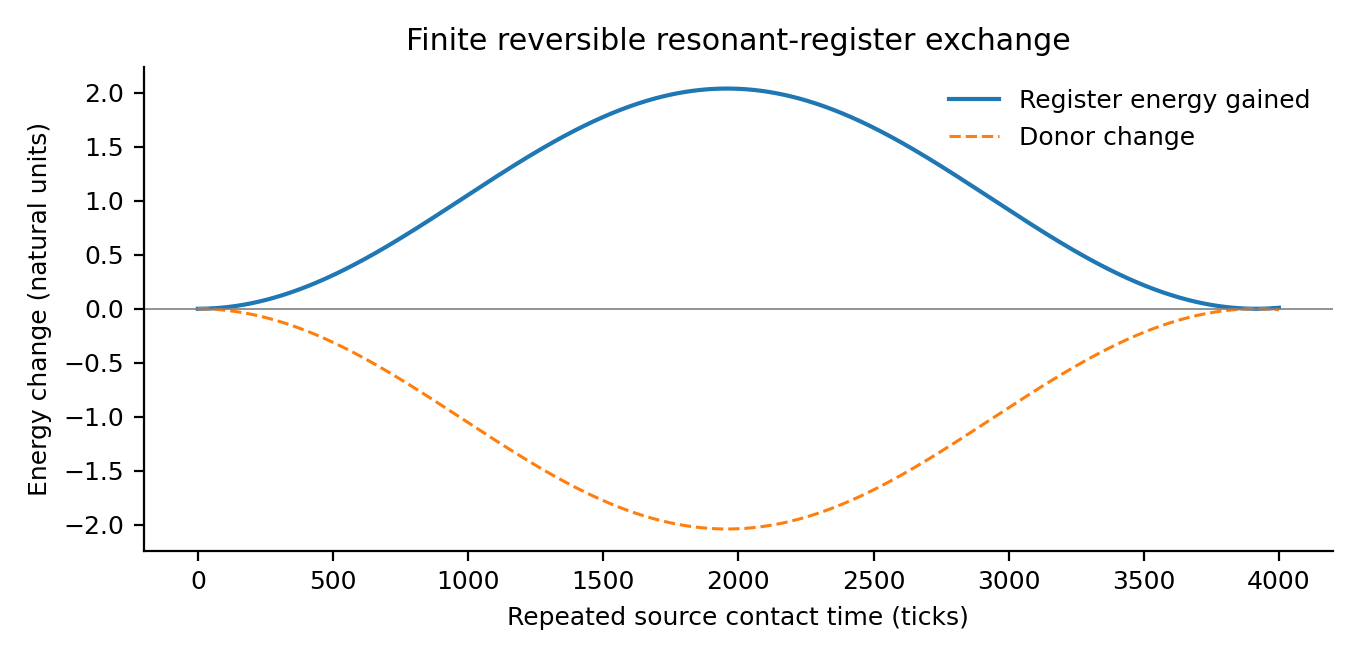
The source-energy entry and the work delivered to the accepting load remain explicitly represented in the energy ledger.
5. Static Magnetic Geometry and Quantum Transport
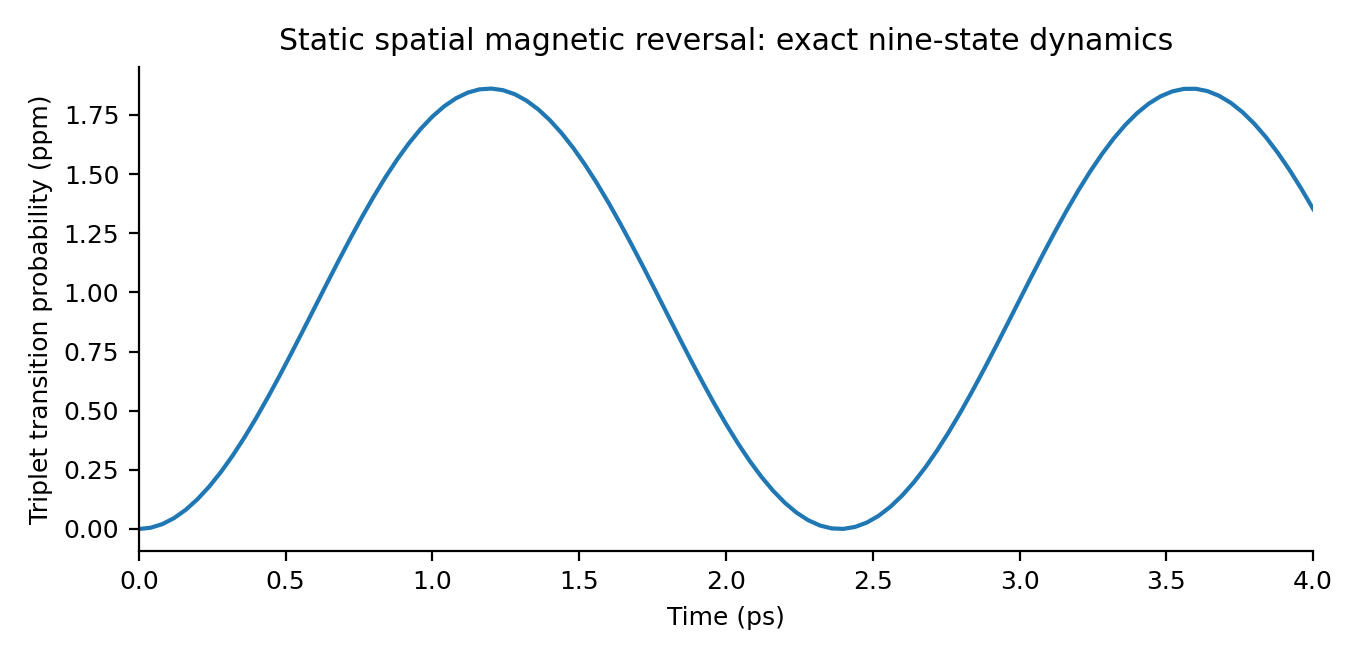
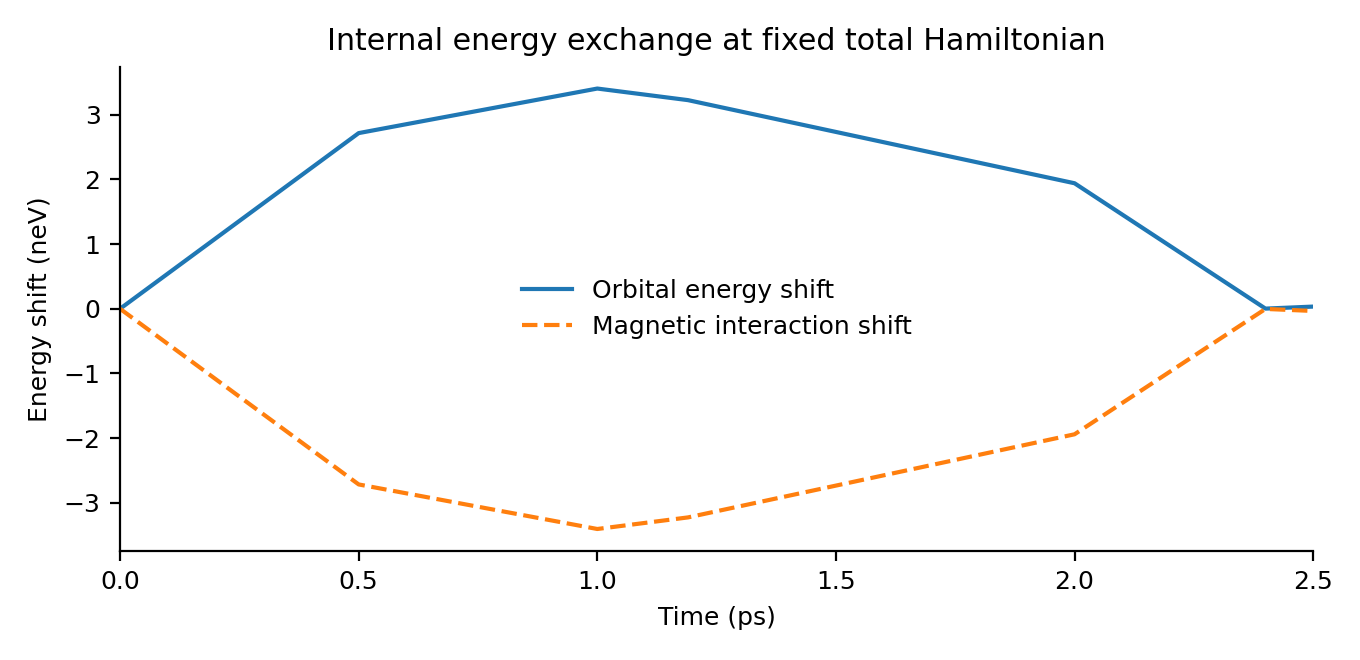
The specialized local model uses a stationary spatially antisymmetric magnetic field and a fixed two-electron sector.
The time-independent magnetic configuration produces no periodically induced electromotive force in the fixed-contour reference model.
The calculations distinguish persistent internal circulation, magnetic-transition amplitudes, resonant contact selection, and exported terminal current.
For the selected three-site ring reference, the equilibrium circulating current is −162.2756537 nA.
The static opposite-face configuration also produces two individually resolved currents of equal magnitude and opposite direction.
The retained source-electron inventory remains fixed during the selected charge-transfer operations.
6. Reflection Selection and the Constructive Port
The two historical addresses generate complementary reflection-even and reflection-odd collective states.
The symmetric neutral-locus contact admits the bright constructive combination and eliminates the selected dark opposition channel.
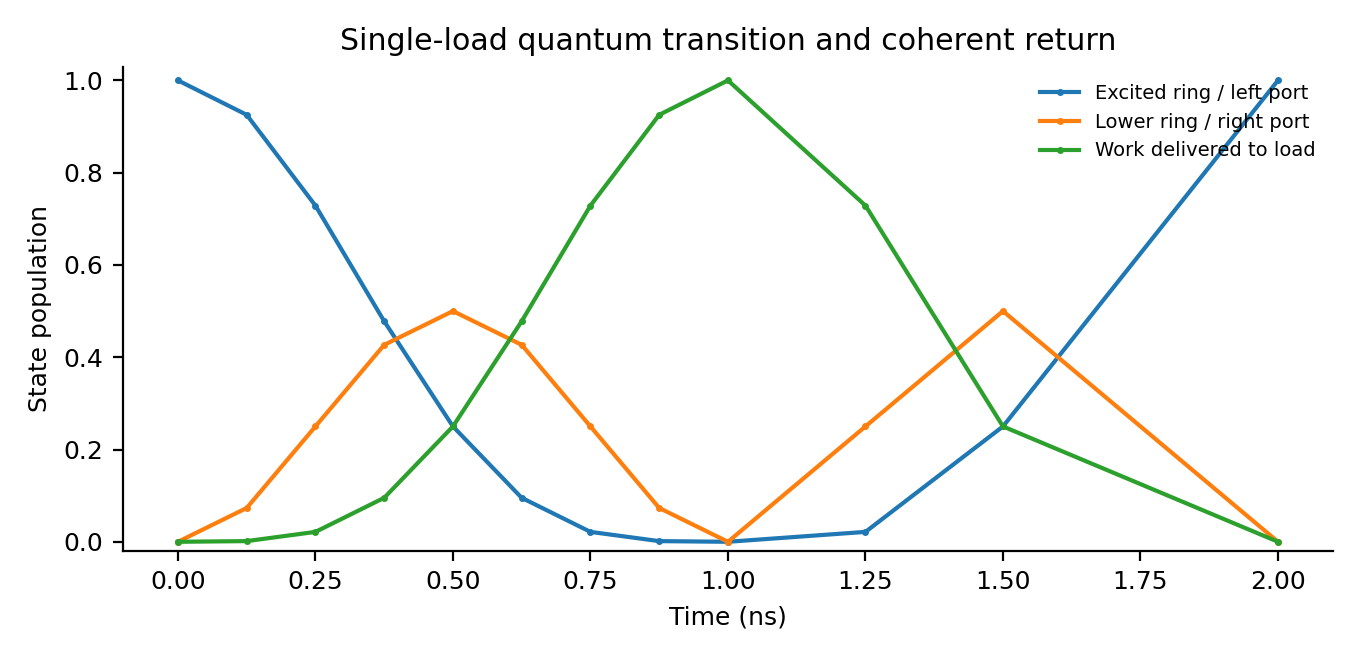
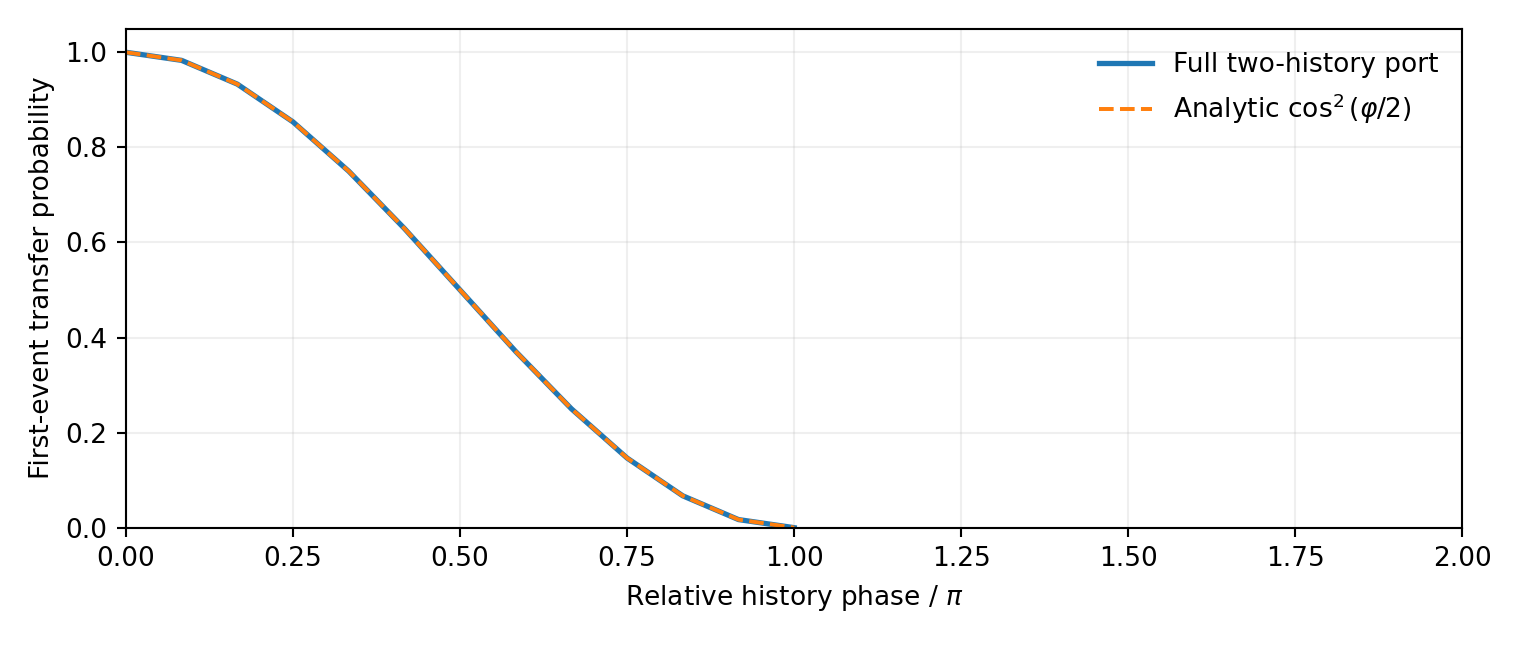
The phase-resolved work-transfer probability follows the squared cosine of half the relative phase.
The published reference calculation gives complete first-event transfer for the phase-matched bright state, one-half transfer probability at an intermediate phase, and zero selected-port transfer for the antisymmetric state.
These values describe normalized quantum transition probabilities within the specified contact model.
7. Constructive Preparation and Electrical Work
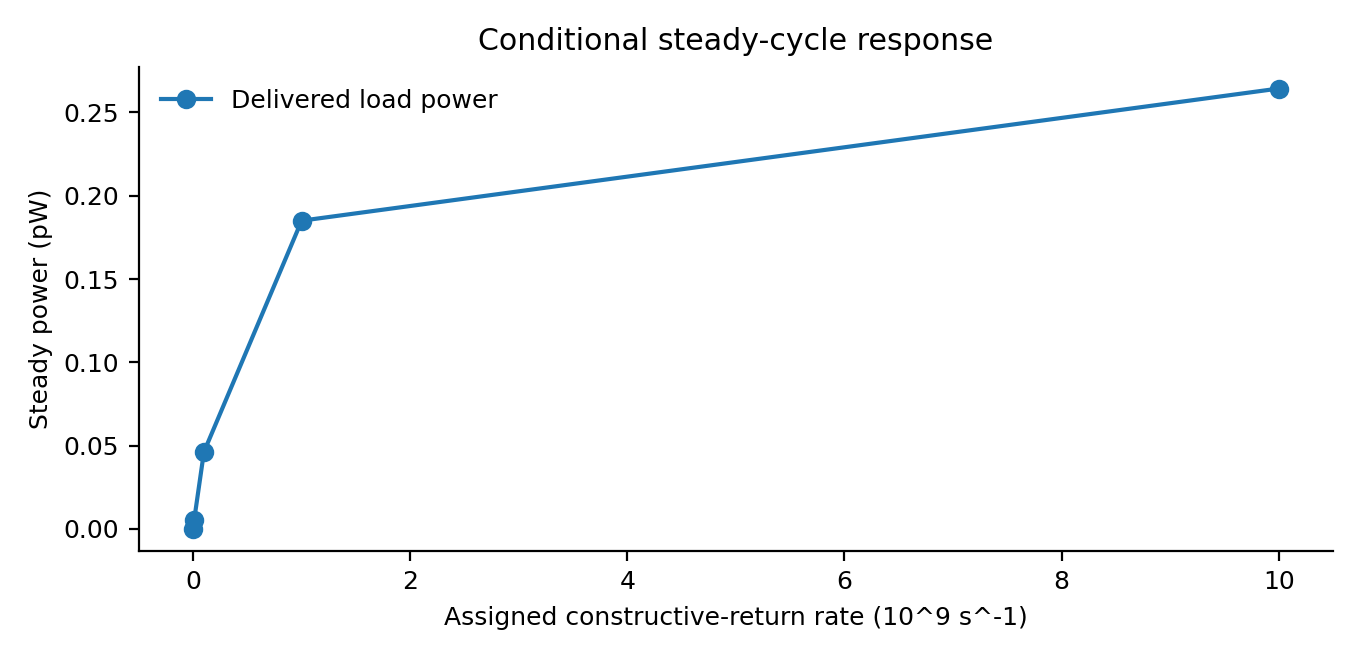
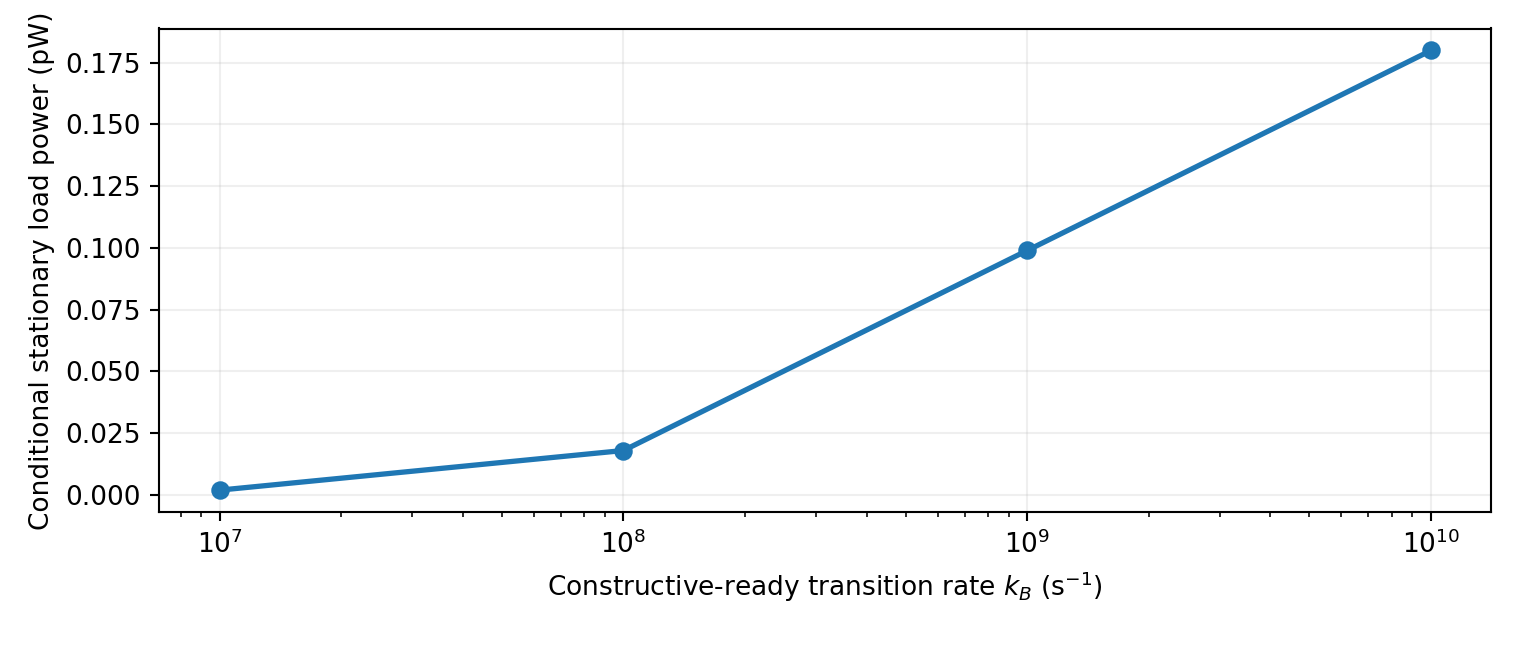
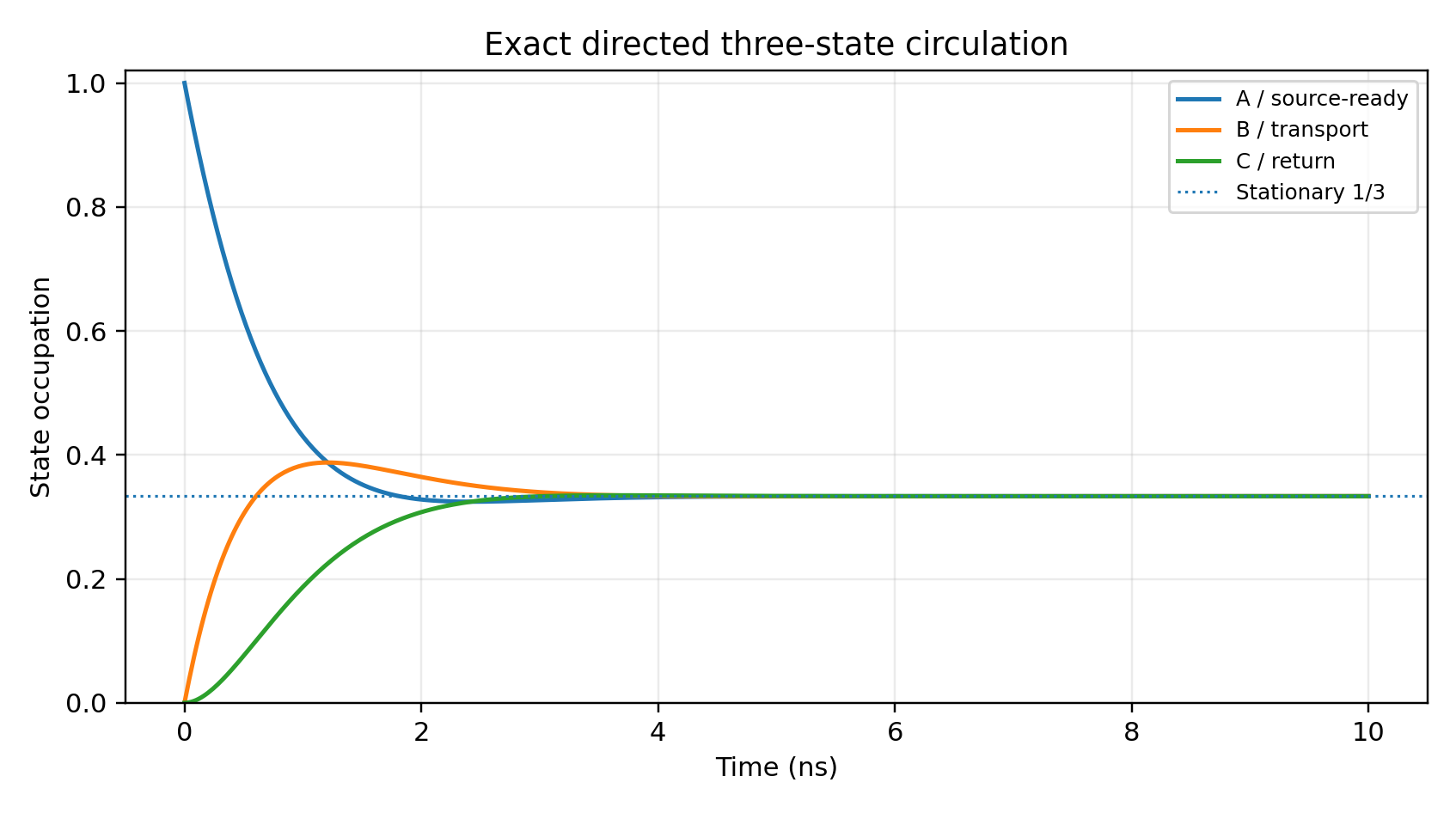
The electrical cycle comprises constructive-ready preparation followed by discharge into a receiving load.
The upward transition receives its energy through the M1-coupled constructive-return boundary defined in the model.
The downward transition transfers the corresponding energy quantum to the terminal work register.
For positive preparation and discharge rates, the stationary cycle has equal completed-transition fluxes.
The matched microscopic reference yields:
| Calculated quantity | Reference value |
|---|---|
| Bright contact amplitude | 42.58796557 µeV |
| First-event completion time | 34.33315766 ps |
| Work quantum | 1.979241503269099 × 10⁻²² J |
| Matched preparation rate | 10⁹ s⁻¹ |
| Matched discharge rate | 10⁹ s⁻¹ |
| Stationary completed-cycle flux | 5 × 10⁸ s⁻¹ |
| Stationary load current | 80.1088317 pA |
| Stationary load power | 0.09896207516 pW |
The numerical values describe the documented microscopic reference configuration.
8. Demand-Responsive Transfer and Energy Conservation
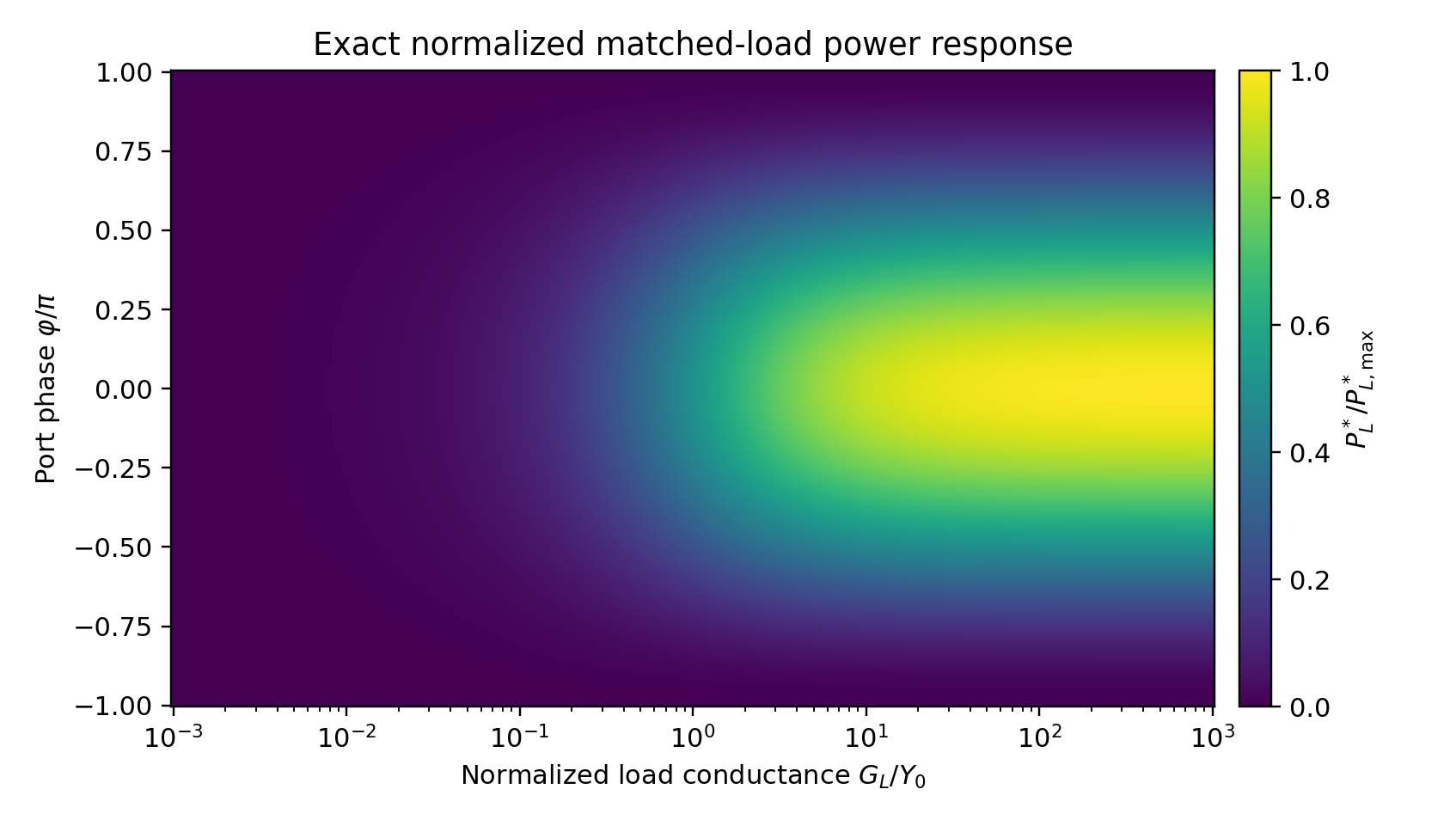
The reciprocal load gate couples constructive preparation and discharge to the conductance and accepting phase of the connected receiver.
For accepted demand, the selected port transfers positive work.
For an open circuit or opposite accepting phase, both selected-port rates vanish. The retained electron inventory, historical registers, and static magnetic organization remain present.
The exact ON–OFF–ON calculation reproduces interruption and restoration of electrical work:
| Operating interval | Mean calculated load power |
|---|---|
| 0–4 ns: ON | 0.08659596553 pW |
| 4–8 ns: OFF | 0 |
| 8–12 ns: ON | 0.09895792680 pW |
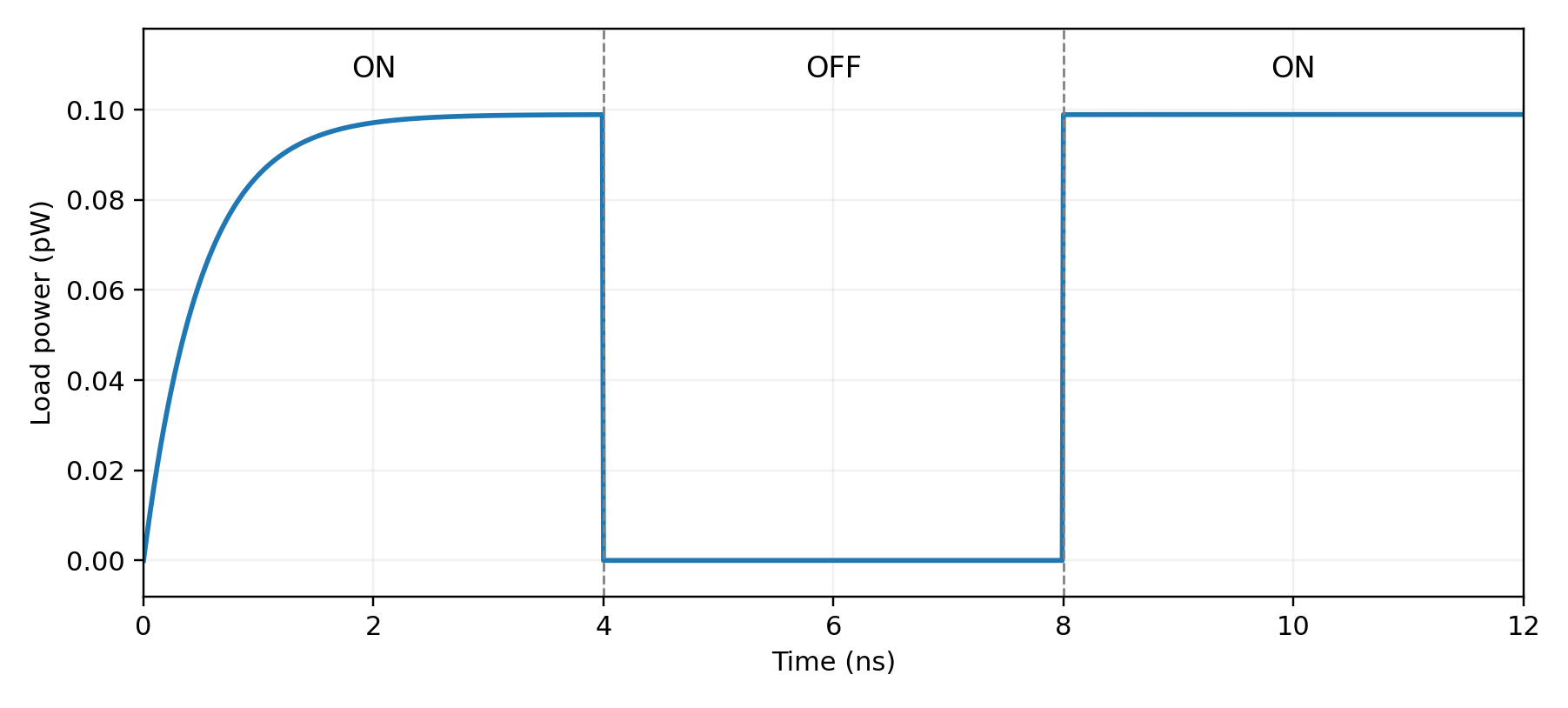
Across the complete reference protocol, the integrated energy-account residual is smaller than 1.3 × 10⁻³⁸ J.
The selected reflection-odd opposition channel has zero deposited-power diagnostics. The complete conductor, receiver, thermal, and contact-energy accounts remain separately defined.
9. Empirical Silicon Chronology and Intensity Blindness
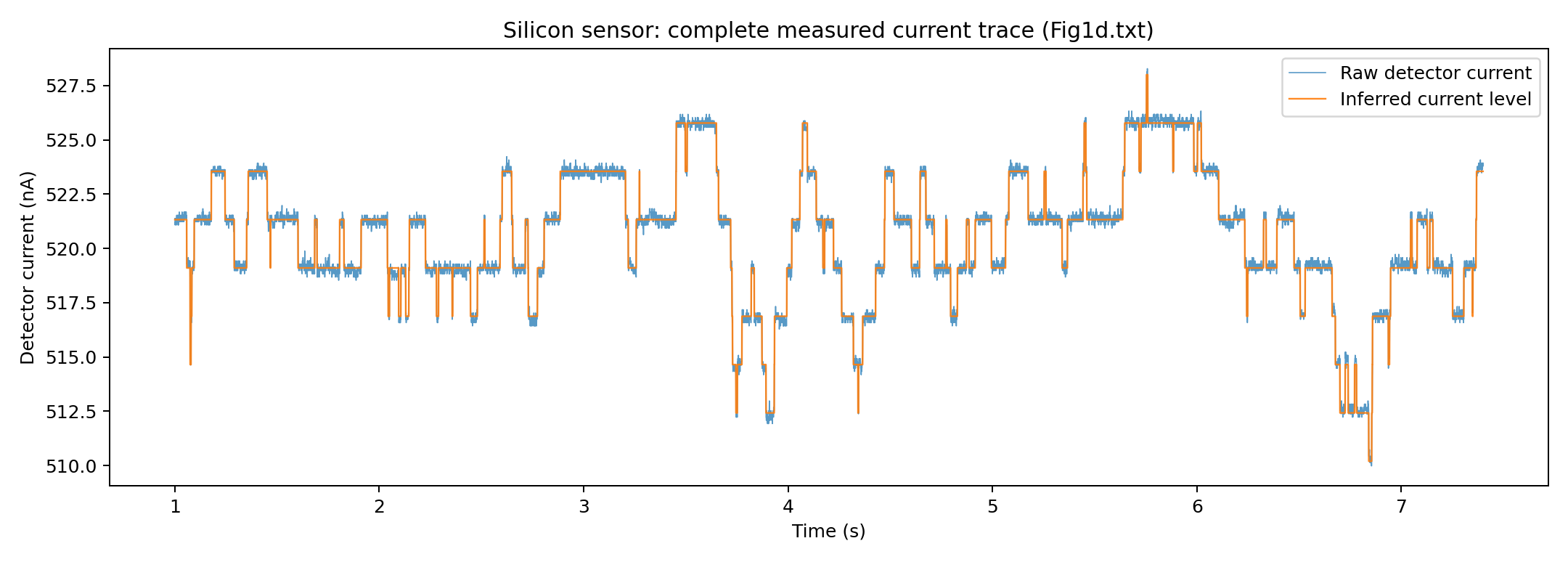
The measured silicon single-electron charge-sensor dataset of Nishiguchi and collaborators provides 10,000 time-ordered current samples.
The original sampling interval is 0.00064 s, spanning 6.39936 s between the first and last samples.
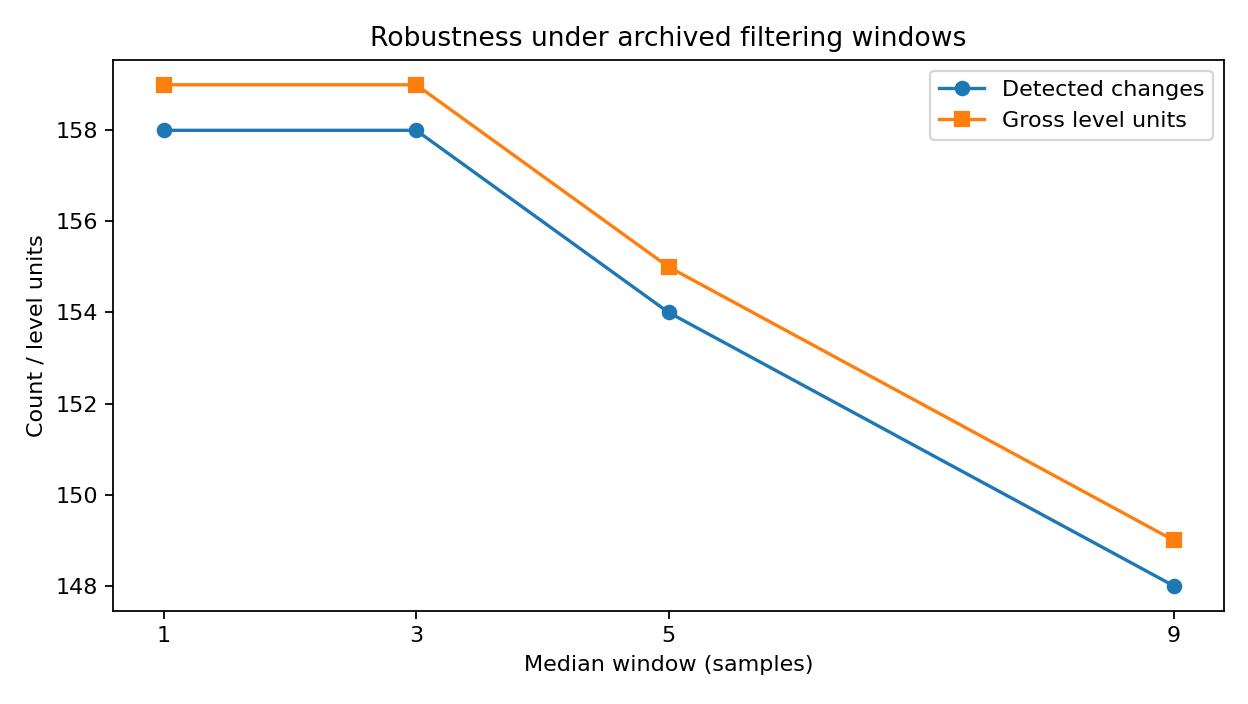
The nine-level reconstruction resolves 158 transition events:
- 80 upward events.
- 78 downward events.
- 80 upward level units.
- 79 downward level units.
The gross transition activity is 159 level units, while the final signed endpoint difference is one level unit.
The endpoint aggregation therefore omits 158/159 of the resolved gross transition activity, corresponding to 99.37106918%.
This fraction measures information absent from the signed endpoint summary, rather than an electrical-energy conversion fraction.
The chronological record preserves the measured sequence of individual level changes.
10. Statistical Examination of Temporal Persistence
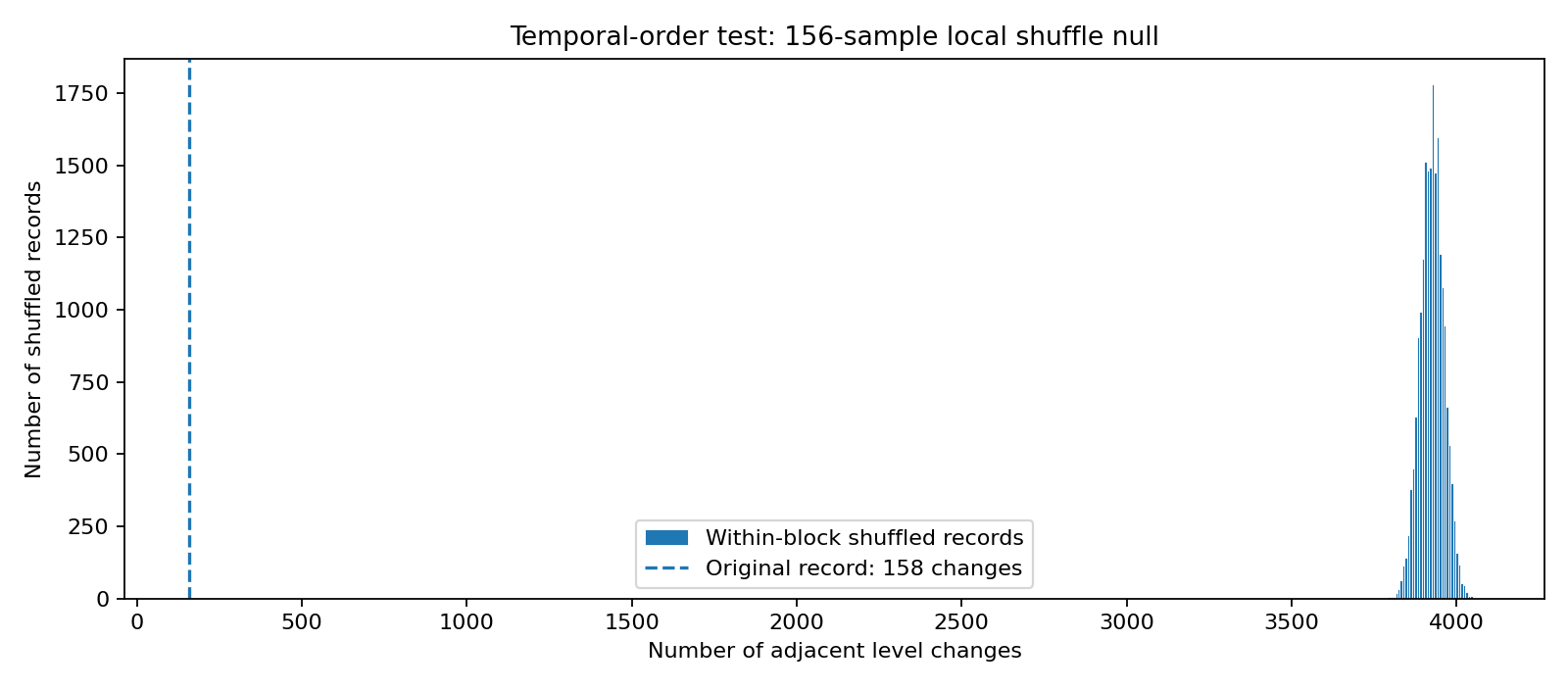
The measured detector sequence is evaluated against conditional within-block permutation models.
Three block sizes are examined, with 20,000 permutations for each configuration.
| Permutation block size | Observed transitions | Null mean | Extreme permutations |
|---|---|---|---|
| 40 samples | 158 | 1770.51 | 0/20,000 |
| 156 samples | 158 | 3925.05 | 0/20,000 |
| 10,000 samples | 158 | 7711.23 | 0/20,000 |
The plus-one Monte Carlo tail estimate is 4.9997500 × 10⁻⁵, corresponding to a one-sided Gaussian-equivalent resolution of 3.89060 standard deviations.
The stated Monte Carlo uncertainty lower score is 3.61569 standard deviations.
The statistical result establishes temporal persistence of the measured silicon current levels relative to the specified exchangeability models.
The measured chronology and the theoretical ME₀ source-to-load construction occupy separate evidentiary registers.
11. Scientific Reproducibility
The publication and its computational materials document the inherited source structure, quantum transport calculations, magnetic reference models, reflection selection, stationary rate equations, energy-account identities, silicon event reconstruction, and statistical examination.
The numerical examination includes:
- Positive-frequency source projection.
- Fixed-number quantum transport.
- Resonant work transfer.
- Spatial magnetic reflection.
- Bright and dark contact selection.
- Stationary two-state and three-state kinetics.
- Reciprocal demand gating.
- Integrated energy accounting.
- Silicon chronological reconstruction.
- Conditional permutation and filtering sensitivity.
The original silicon dataset is independently accessible through its published DOI.
The reproduction package has been checked and its computational stages replayed. Separate reproduction verification record.
12. Invitation to Independent Scientific Examination
Researchers in quantum physics, electrical engineering, condensed-matter physics, energy systems, and computational science are invited to examine the complete mathematical construction and its documented numerical and empirical results.
Suggested examination points include the historical-functional register map, reflection selection, source-to-port transduction, charge continuity, stationary energy balance, demand-responsive gating, and statistical reconstruction of measured detector chronology.
Physical realization of the complete ME₀ generating architecture is a distinct experimental program requiring the measurement of terminal work and all system-energy inputs.
Original silicon research dataset: 10.5281/zenodo.7431564
Full scientific publication and reproduction archive: 10.5281/zenodo.24137835