The Shadow Sun: Beyond the Blindness of Intensity
A Multi-Spacecraft Search with Direction-Resolved Gamma Rays
Read the original publication and computational materials ↗1. The Scientific Question
Can direction-resolved astronomical measurements recover information that remains inaccessible to unsigned intensity observations?
Paper XXIX develops an observational search for the predicted counterpart stellar role, the Shadow Sun, through independently reconstructed photon histories, multi-spacecraft geometry, and calibrated directional gamma-ray measurements.
2. The Blindness of Intensity
The inherited observable construction distinguishes two directed contributions to a common detection class.
Unsigned intensity combines the two contributions, while directed contrast distinguishes their difference.
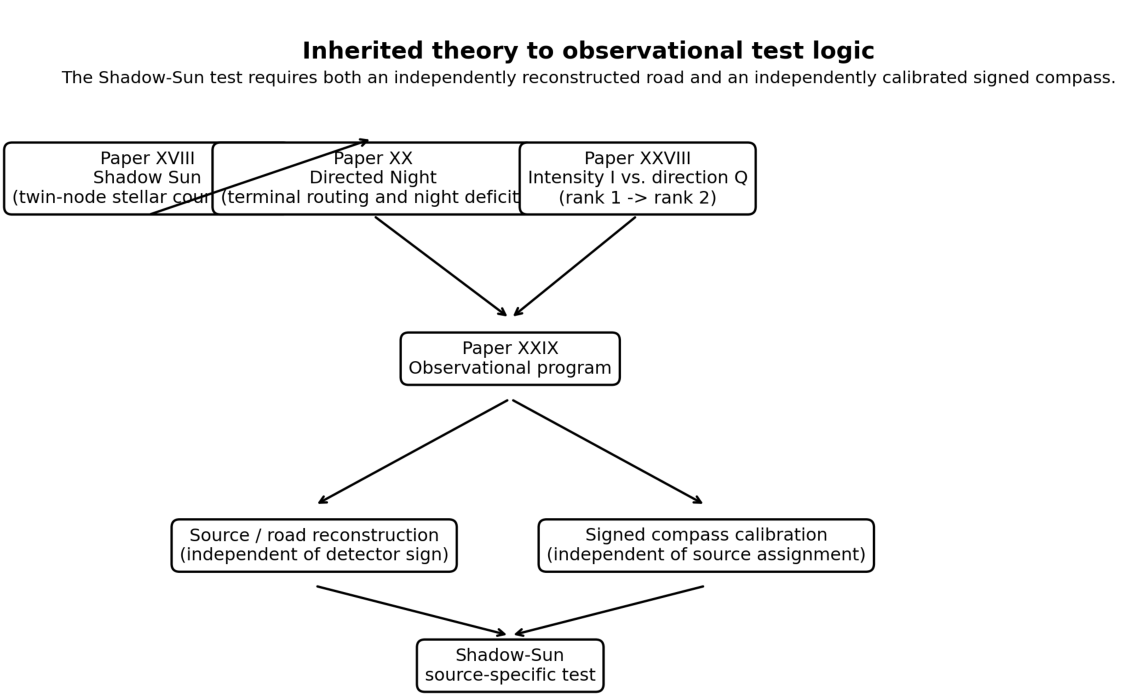
Intensity-only inversion has rank one and a nontrivial kernel. Joint access to intensity and directed contrast yields a rank-two reconstruction.
Within the STDG twin-node construction, the ordinary human-aware realization is associated with unresolved intensity and the luminous solar channel. The parallel aware realization is associated with direction-resolved access and the Shadow-Sun channel.
The observational program investigates the physical measurement architecture required to distinguish these directed contributions.
3. Independent Photon History and Detector Directionality
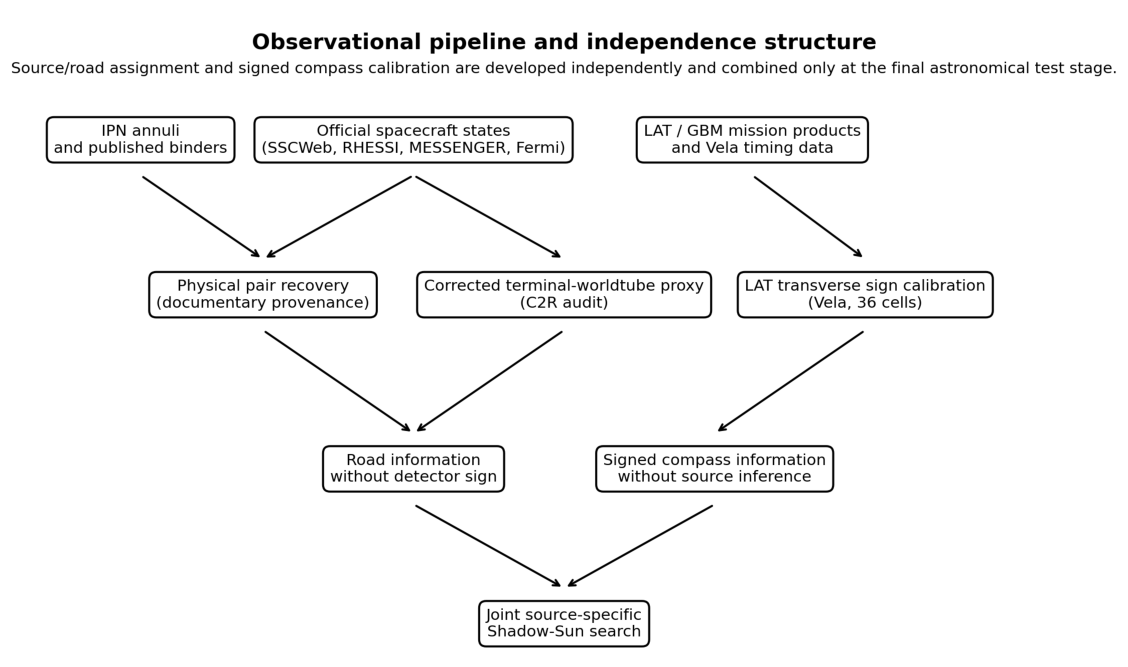
The scientific measurement architecture separates two information streams:
- The independently reconstructed transport or source history, termed the road.
- The independently calibrated signed detector response, termed the compass.
The full directed photon history retains outbound orientation, arrival orientation, circulation count, and additional inherited geometric labels.
A terminal first-encounter label is a coarse projection of this history and does not uniquely reconstruct it.
The finite-dimensional road–compass construction produces a vanishing commutator, road-only informational rank two, joint informational rank four, and a minimal reconstruction determinant of −4.
Instrumental orientation sensitivity and astronomical source attribution are evaluated as distinct scientific levels.
4. Multi-Spacecraft Observational Infrastructure
The IPN/Fermi sample comprises 149 gamma-ray events and 249 localization annuli between 12 July 2008 and 11 July 2010.
Spacecraft-state reconstruction preserves native mission epochs, coordinate frames, source provenance, and interpolation boundaries.
| Spacecraft | Published eligible-state coverage |
|---|---|
| MESSENGER | 149/149 |
| Wind/Konus | 149/149 |
| RHESSI | 122/122 |
| INTEGRAL | 123/123 |
| Mars Odyssey | 117/117 |
| Fermi strict dual-epoch recovery | 142/149 |
The spacecraft coverage denominators correspond to their respective eligibility criteria.
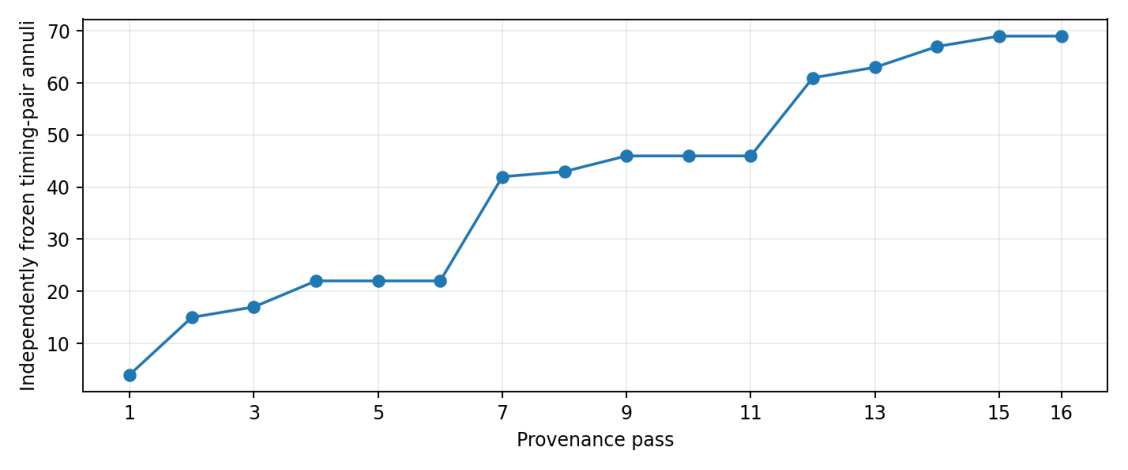
Independent documentary reconstruction establishes 69 physical timing-pair identities among the 249 published annuli. Of these, 61 involve Konus timing and eight exclude it.
Timing-pair identity is established independently of detector presence and directional readout.
5. Corrected Terminal-Worldtube Geometry
The corrected terminal-worldtube calculation evaluates 10,890 candidate configurations.
The published robust one-sided maxima are:
- Negative assignments: 56.
- Positive assignments: 60.
These extrema occur in separate configurations. The positive maximum belongs to the specified rotated control geometry.
No candidate satisfies the simultaneous requirement of at least 15 robust assignments on each side.
The terminal first-encounter projection is non-injective with respect to the inherited full directed photon history.
The full-history source association and the independently calibrated detector response therefore remain essential components of the astronomical counterpart search.
6. Independent Fermi-LAT/Vela Calibration
The Vela pulsar supplies an independently timed gamma-ray calibration source.
The physical orientation sign is determined from source astrometry and spacecraft attitude, independently of reconstructed event azimuth.
The measured directional statistic is the cosine of the reconstructed transverse azimuth.
The calibration uses four energy bins, three incidence-angle bins, and three transverse-angle bins, forming 36 prescribed nuisance cells.
Pulsar phase selection supplies the ON/OFF background-subtraction procedure. The directional coefficient is estimated from the difference between the two physically anchored orientation means.
The FIT and VALIDATION populations are separated by spacecraft observation intervals rather than individual photons.
7. Published Event Selection and Directional Measurements
| Observational quantity | Published result |
|---|---|
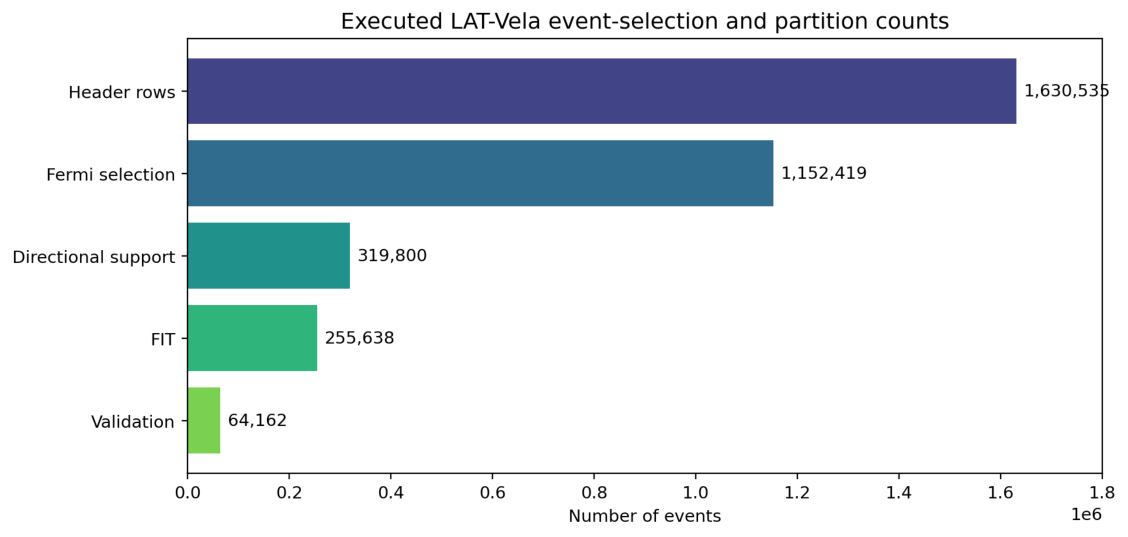
| Original LAT event rows | 1,630,535 |
| Officially selected events | 1,152,419 |
| Directionally supported events | 319,800 |
| Positive-orientation events | 164,608 |
| Negative-orientation events | 155,192 |
| FIT events | 255,638 |
| VALIDATION events | 64,162 |
| Positive fitted directional coefficients | 36/36 |
| Cells reaching the prescribed five-standard-error threshold | 34/36 |
| Median directional coefficient | 0.9174675296503296 |
| Maximum standardized coefficient | 498.80954073229253 |
The two remaining cells retain positive coefficients:
- Cell 28: 4.793087073596847 standard errors.
- Cell 30: 4.551852033789080 standard errors.
Independent numerical recalculation reproduces all 36 fitted cell estimates at the reported numerical precision.
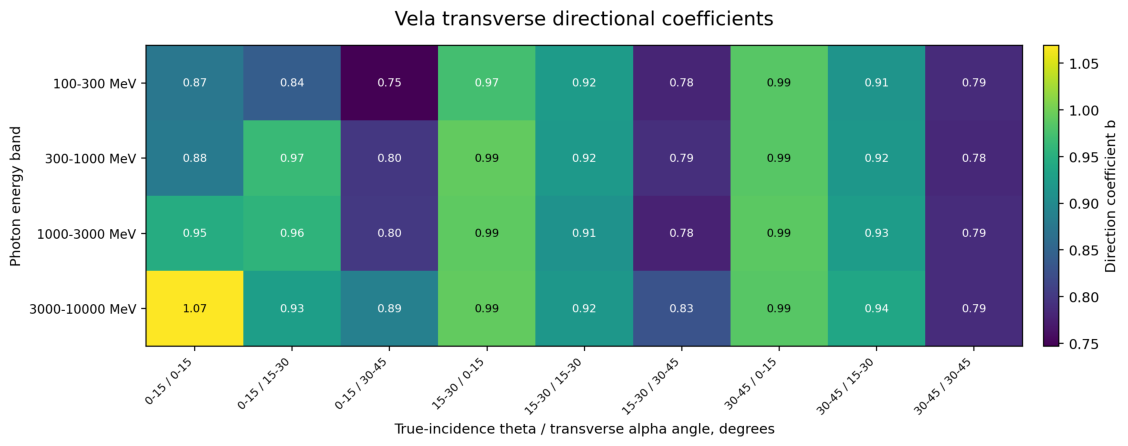
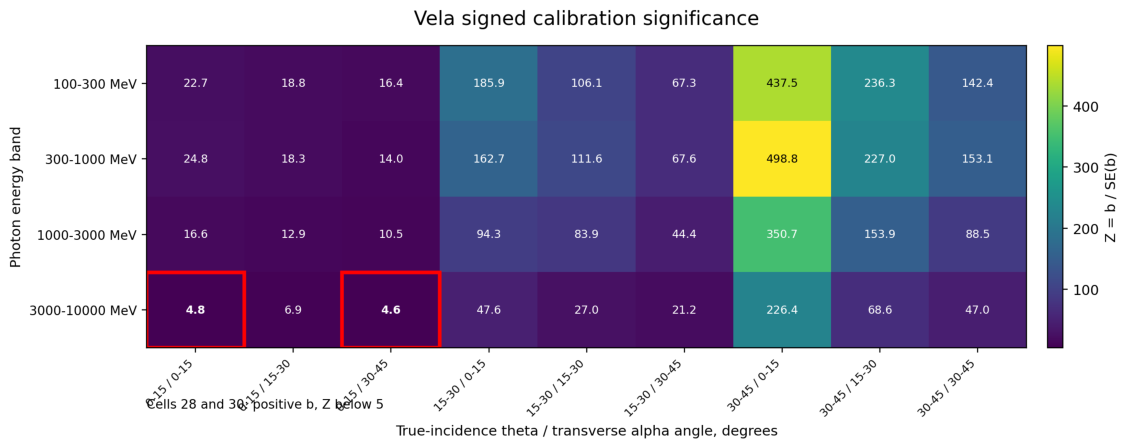
The measured directional response is a quantitative instrumental result. Source-level identification of the predicted stellar counterpart requires the separate association between photon history, calibrated detector directionality, and the astronomical source.
8. Complementary GBM Detector Geometry
The antipodal BGO0 and BGO1 detector axes supply a complementary hardware coordinate for signed measurements.
The official response-product database contains 544 detector-response files across two detectors.
Within the prescribed angular support, 88 directions form 44 antipodal pairs, comprising 35 analysis pairs and nine validation pairs.
The selected common energy range contains 26 matched energy bins.
These results characterize detector geometry and response-product symmetry within the direction-resolved measurement architecture.
9. Scientific Reproducibility
The accompanying research archive contains:
- The complete 249-row IPN source ledger.
- Independently documented timing-pair evidence.
- Pair-provenance reconstruction code.
- Terminal-worldtube geometry and road–compass calculations.
- Versioned spacecraft-state evaluators.
- The complete 36-row LAT–Vela calibration table.
- Independent cellwise numerical verification.
- Event-level FITS source-to-geometry verification code.
- Source identities and SHA-256 integrity manifests.
The published provenance records identify the original mission products and the associated acquisition and calibration settings.
Full event-level regeneration requires the corresponding original mission data. The original raw C1/C2R arrays are not included in the distributed supplementary package.
10. Invitation to Independent Scientific Examination
Astronomers, gamma-ray physicists, astrophysicists, instrument scientists, mathematicians, and computational researchers are invited to examine the complete observational architecture and reproduce its documented results.
Suggested examination points include:
- Intensity-only non-identifiability and directed reconstruction.
- Independent spacecraft timing-pair provenance.
- Native spacecraft epochs and coordinate transformations.
- Full photon-history observables and terminal non-injectivity.
- Physical detector orientation independent of reconstructed azimuth.
- The LAT–Vela ON/OFF estimator and cellwise uncertainty model.
- The independent road–compass information structure.
- Source-level astronomical counterpart association.
Foundational stellar construction — Paper XVIII: 10.5281/zenodo.22937766
The Blindness of Intensity — Paper XXVIII: 10.5281/zenodo.23145251
Full observational publication and computational materials — Paper XXIX: 10.5281/zenodo.23298421