Galactic Centers and Dark-Matter-Free Flat Rotation
Read the original publication and reproduction archive ↗1. The Scientific Question
Can a single regular geometric mechanism account for both the internal structure of galactic centers and the flat outer rotation of galaxies?
Paper XIII of Six-Throat Directed Geometry develops a galactic-center parity-conversion mechanism that connects central regularity, exterior gravitational response, galactic rotation, and compact nuclear radio activity.
2. The Mathematical Construction
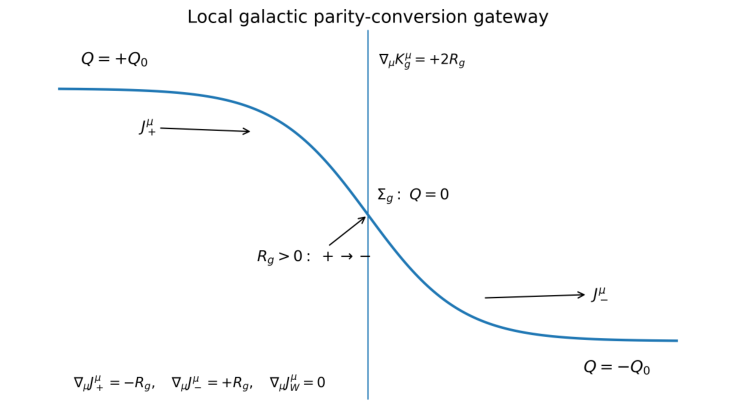
The galactic center is represented as a smooth parity-conversion region through which material polarization undergoes a continuous transition while conserving total transported weight.
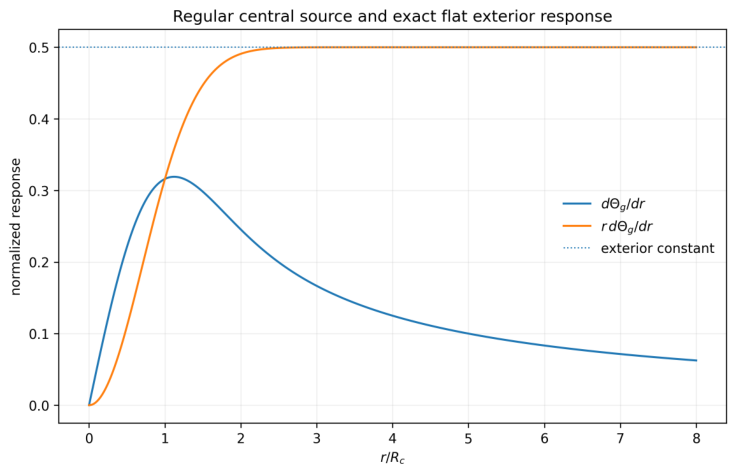
The integrated geometric conversion source generates an exterior reverse-tension acceleration proportional to the inverse radial distance.
The resulting circular-speed contribution is radius-independent outside the compact conversion region.
The observational rotation equation combines the baryonic contribution with one nonnegative, radius-independent geometric contribution estimated separately for each galaxy.
The dark-halo coefficient is identically zero in the tested equation.
3. The SPARC Observational Test
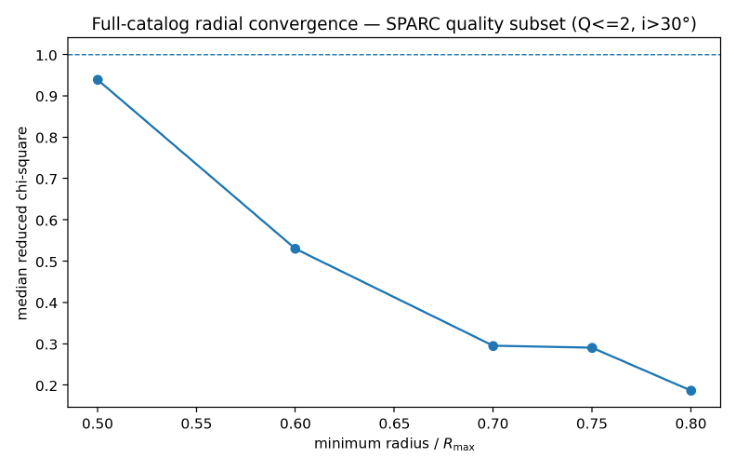
The mechanical analysis uses the full public SPARC mass-model catalog, comprising 175 galaxies and 3,391 rotation measurements.
Five radial windows were specified before the catalog-wide analysis. The primary outer-radius window, R/Rmax ≥ 0.75, contains 123 eligible galaxies, including 115 galaxies satisfying the prescribed quality and inclination requirements.
| Primary quality-sample result | Value |
|---|---|
| Galaxies | 115 |
| Median reduced chi-square | 0.2903 |
| Galaxies with reduced chi-square ≤ 2 | 106 |
| Median model RMS | 2.236 km/s |
| Median baryonic RMS | 57.819 km/s |
| Median RMS reduction | 96.21% |
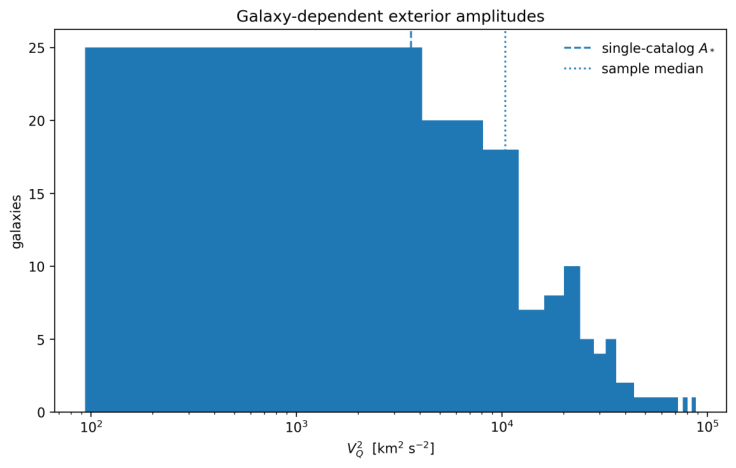
The radial form of the exterior contribution is common across galaxies, while its fitted amplitude is galaxy-dependent.
A single catalog-wide amplitude yields a chi-square of 114,878.02 for 114 degrees of freedom, strongly disfavoring a universal conversion amplitude within the tested model.
4. Independent Radio-Observation Channel
The same geometric conversion throughput generates a separate radiative consequence through a conservative energy ledger.
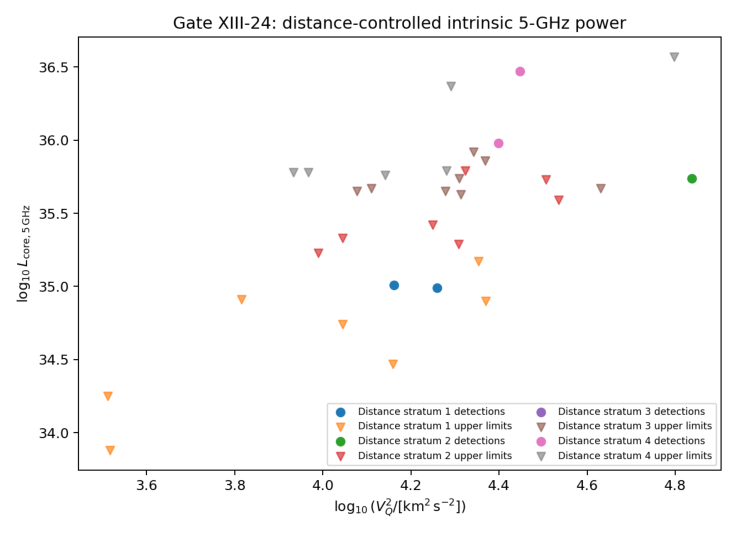
The independent observational channel uses compact 5-GHz nuclear measurements and upper limits from the LeMMINGs VII e-MERLIN survey.
The matched sample contains 33 galaxies, comprising five compact-core detections and 28 upper limits.
| Distance-controlled radio result | Value |
|---|---|
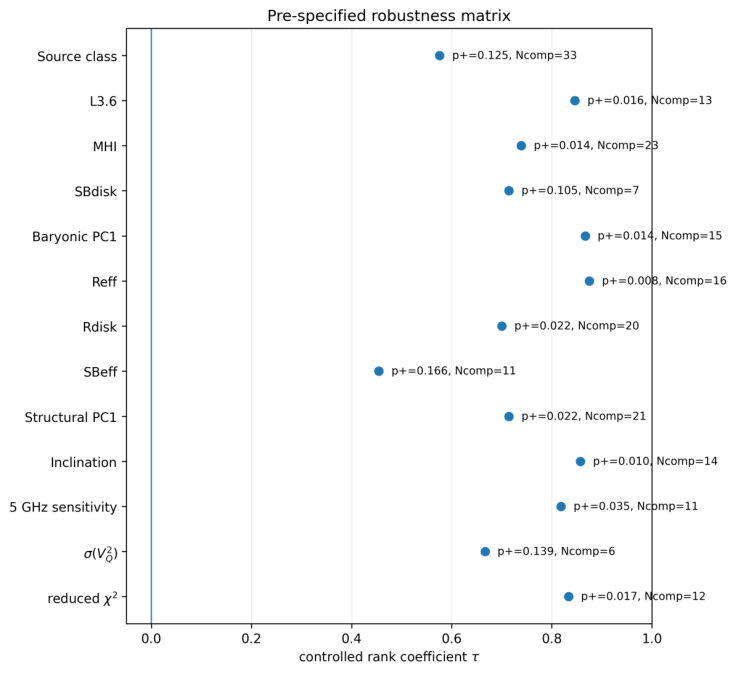
| Partial censored-rank coefficient | 0.78195 |
| One-sided permutation probability | 0.012875 |
| Two-sided permutation probability | 0.037475 |
| Primary permutation realizations | 1,000,000 |
The analysis retains the published censoring structure and controls for distance.
All thirteen prescribed robustness-control coefficients remain positive, with individual permutation probabilities reported in the manuscript.
5. Scientific Reproducibility
The publication archive provides:
- The complete scientific manuscript.
- Original SPARC input tables.
- LeMMINGs VII observational tables.
- Matched and controlled analysis datasets.
- Numerical results and scientific figures.
- A deterministic Python reproduction script.
- SHA-256 file-integrity records.
These materials support independent reconstruction of the primary mechanical results, the central-regularity calculations, the dual-channel numerical witness, and the distance-controlled radio analysis.
Source catalogs: SPARC (Lelli et al.) · LeMMINGs VII (Williams-Baldwin et al.).
6. Invitation to Independent Scientific Examination
Astrophysicists, gravitational physicists, mathematicians, astronomers, and computational researchers are invited to examine the complete mathematical construction and reproduce the published numerical results.
Particular examination points include the conversion-current conservation laws, the regular central-source theorem, the exterior reverse-tension theorem, the SPARC amplitude estimator, and the distance-controlled compact-radio association.
The original manuscript and its reproduction archive are openly accessible.
Full scientific publication and reproducibility materials ↗Six-Throat Directed Geometry — STDG
IBRAHIM MOHAMMED MUSSA