The Antimatter Resolution
Geometric Sorting and Twin-Sector Closure in Six-Throat Directed Geometry
Read the original publication and reproduction archive ↗1. The Scientific Question
Must antimatter be globally absent for the observable cosmological sector to be overwhelmingly matter dominated?
Paper XII develops a geometric mechanism connecting directed-sector identity, statistical birth symmetry, protected central separation, controlled outer mixing, and conservative residual return within one connected closed spacetime.
2. Directed-Sector Identity and Statistical Birth
Material packets are characterized by directed-sector polarization Q and coherence C = |Q|.
Positive and negative polarization identify matter-sector and antimatter-sector material within the model. Both sectors retain positive mass-energy.
A statistically parity-symmetric birth law produces zero ensemble-mean additive sector charge while permitting a finite signed imbalance in an individual realization.
The magnitude of that realized imbalance depends on the correlation structure of the birth process.
Subsequent conservative sorting redistributes the sector labels without manufacturing or eliminating a global signed abundance bias.
3. The Zero-Region Sorting Mechanism
The parity-preserving orientation field inherited from Paper XI produces equal-and-opposite directed acceleration for opposite-sector constituents.
The protected return condition depends on packet coherence, incident energy, and the inherited orientation coupling.
Sufficiently coherent material returns to its native directed sector before opposite-sector overlap.
For the frozen Paper XI reference benchmark, the critical coherence is 0.5.
At unit coherence, the dimensionless turning coordinate is 0.7966554516333814, producing a protected exclusion width of 1.5933109032667627.
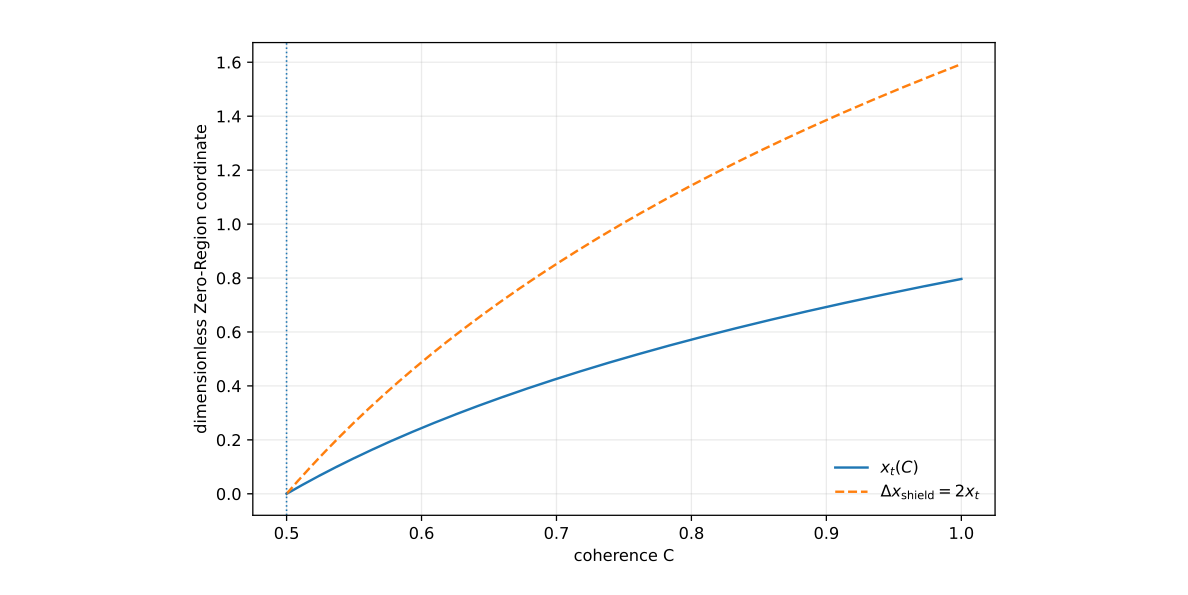
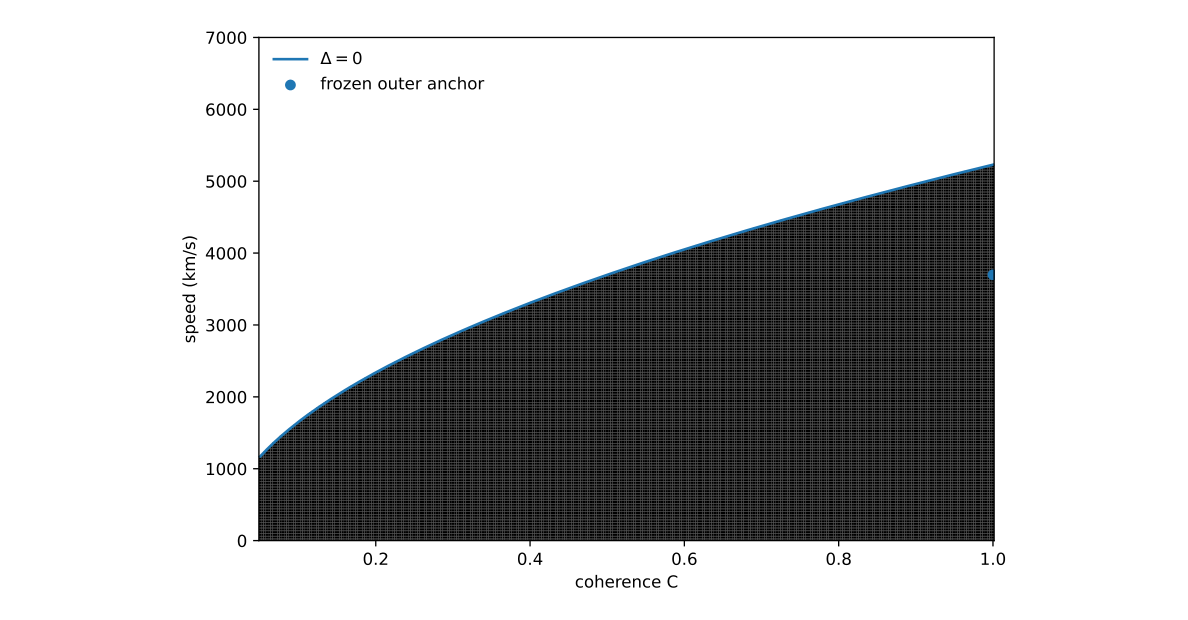
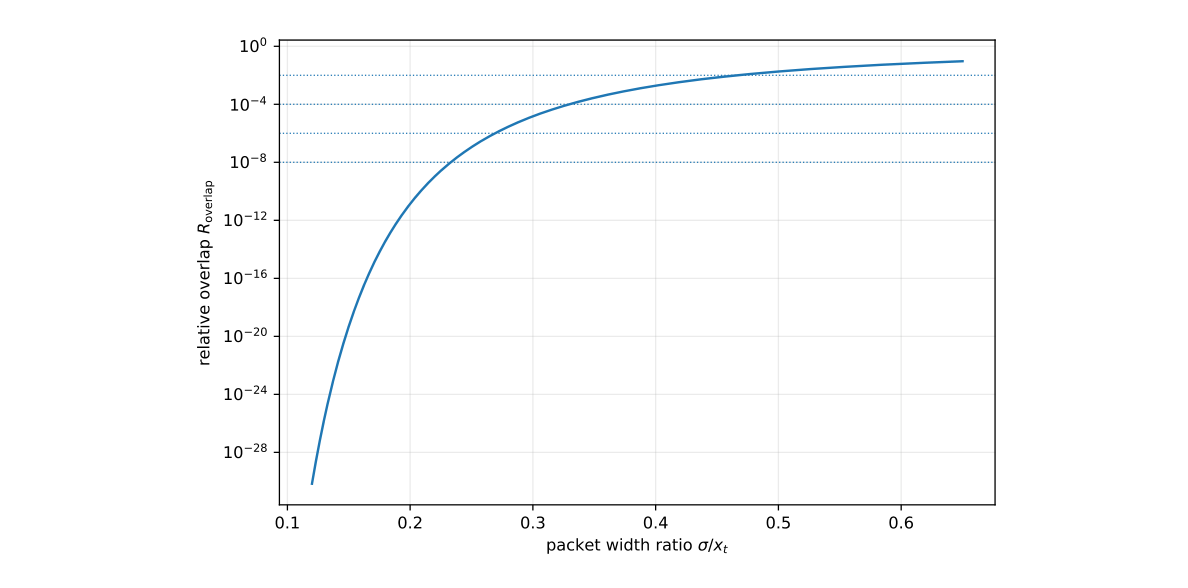
The hard-support construction eliminates direct overlap exactly. Finite-width Gaussian packets exhibit exponential overlap suppression.
4. Leakage and Controlled Outer Mixing
Material below the protected-return threshold enters the inherited throat-processing hierarchy.
The unprotected fraction and the fraction subsequently reaching the outer mixed region are distinct quantities.
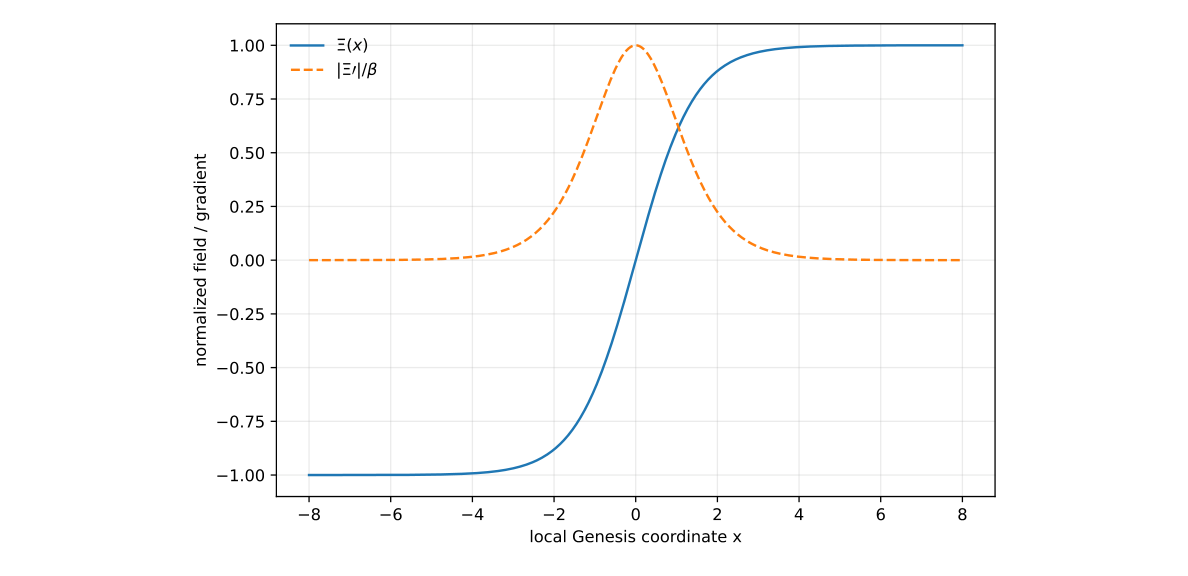
At the outer interface E_G, the selected residual stream is permitted to mix. No second protected-return barrier is imposed on this stream.
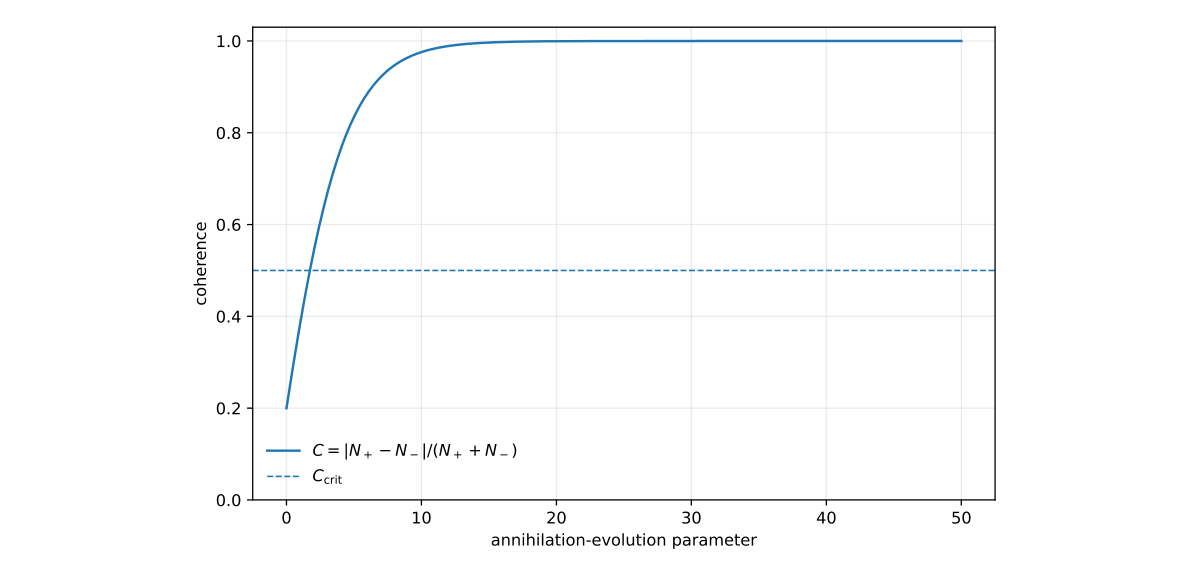
Pair annihilation removes the pair-symmetric component while conserving the signed excess.
As the surviving pairable inventory decreases, the residual approaches unit sector coherence.
5. Stable Residual Return
The surviving signed excess enters the conserved global return current established in Paper V.
For the source-free annihilating parcel, the signed difference is conserved:
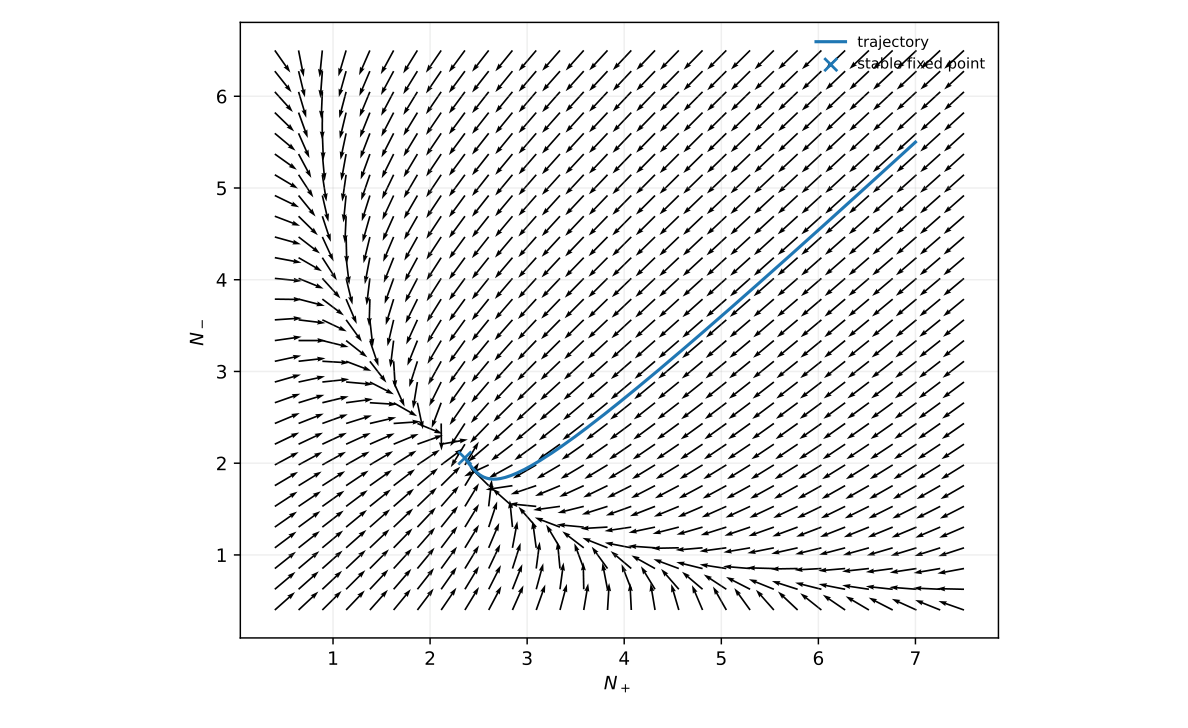
A two-species annihilation-and-return system yields a finite fixed point even when the realized matter-sector and antimatter-sector feed rates are unequal. For the branch J₊ ≥ J₋:
The published numerical witness uses:
- Positive-sector feed: 1.03.
- Negative-sector feed: 0.97.
- Reaction coefficient: 0.2.
- Effective return parameter: 5.
The resulting fixed point is:
- Positive-sector inventory: 2.35737400546441.
- Negative-sector inventory: 2.05737400546441.
Both Jacobian eigenvalues are negative, establishing local attraction for the stated numerical witness.
6. Twin-Sector Geometry and Conservative Circulation
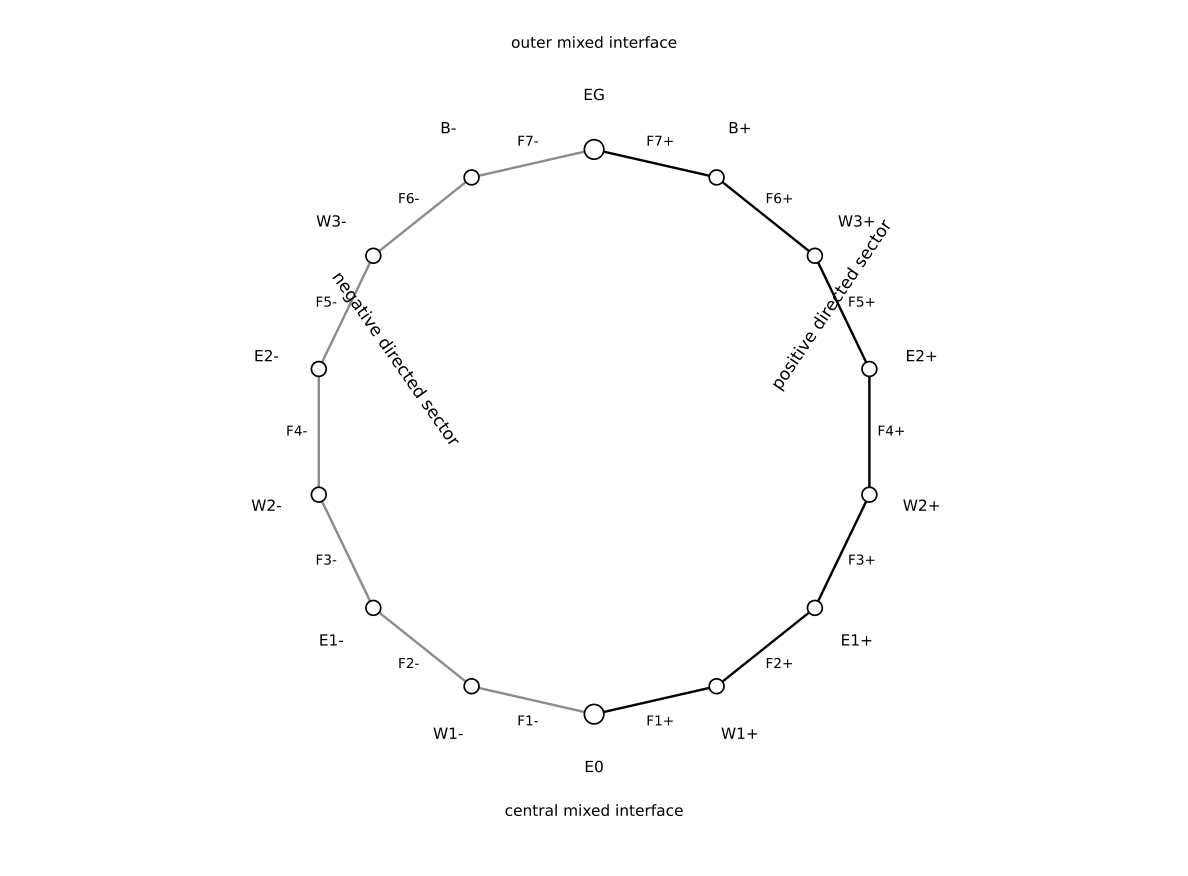
The inherited fourteen-face incidence cycle supports two reflection-related directed sectors embedded within one connected periodically closed spacetime.
The central interface E₀ provides protected separation and native-sector return.
The outer interface E_G provides controlled mixing, conversion, and residual recycling.
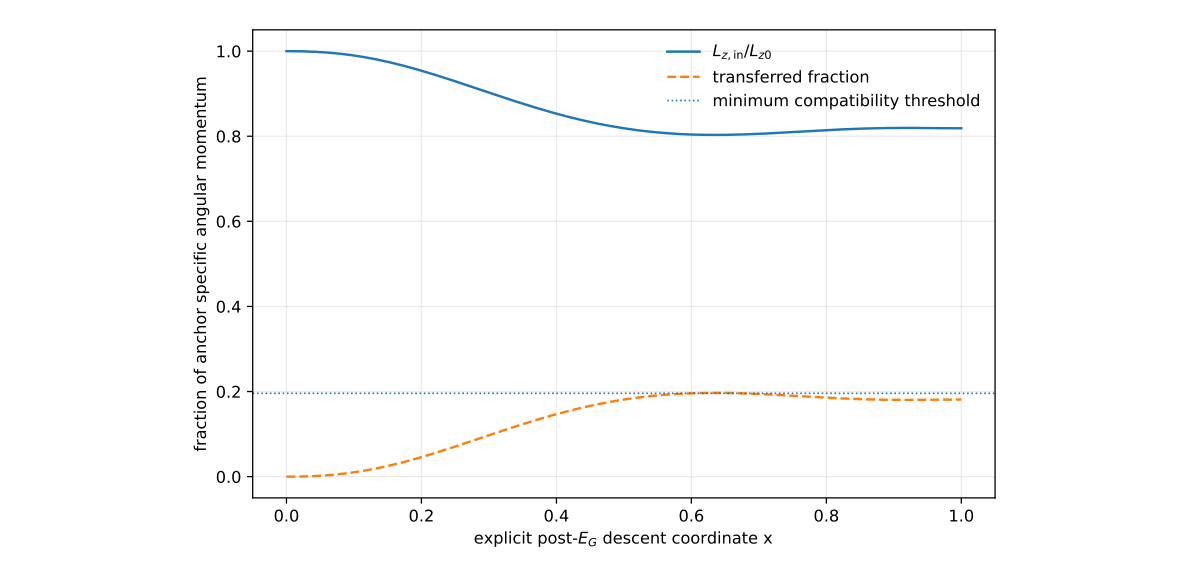
Conservative local redistribution of axial angular momentum permits an inward packet to traverse the explicit return geometry while preserving the total angular momentum of the system.
The constructive numerical witness gives a peak transferred angular-momentum fraction of 19.684%.
The angular-momentum ledger and the additive sector-charge ledger remain distinct conserved structures.
7. Energetic Closure and Observational Constraints
Annihilation converts internal rest energy into radiation, wave energy, and other internal reservoirs.
The closed-system energy ledger conserves total energy when all transfers remain internal.
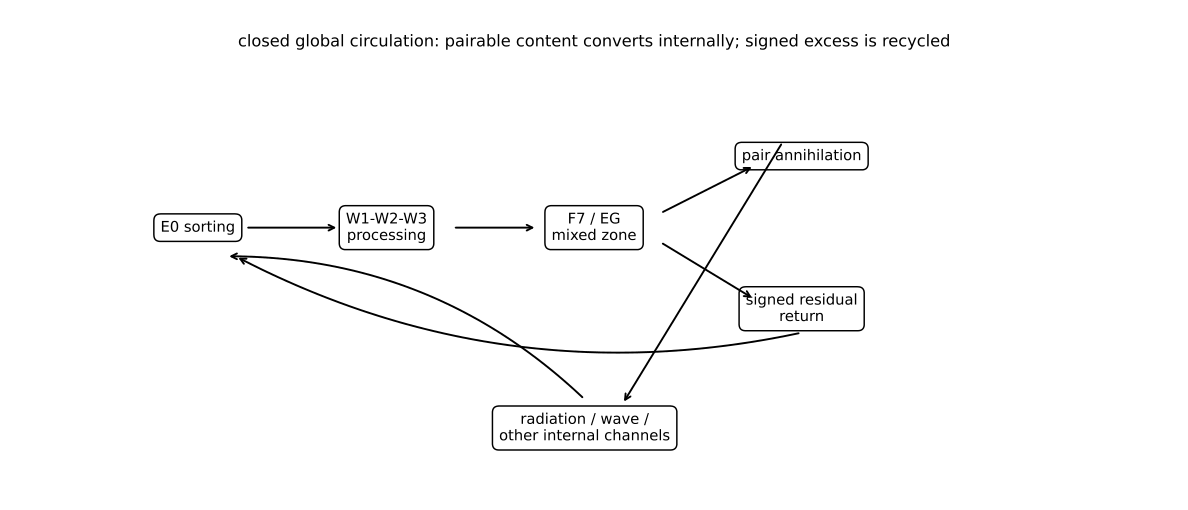
The protected hard-support channel has zero direct annihilation overlap. Finite-width overlap is governed by the derived suppression factor.
Gamma-ray and antistar constraints enter through the fraction of opposite-sector material that actually reaches a matter-rich region.
The absolute leakage fraction, physical annihilation luminosity, and microscopic sector-birth correlations remain quantitative model inputs.
The construction addresses macroscopic geometric sorting and accessibility. The complete Standard Model charge-conjugation spectrum remains external microphysics.
8. Published Numerical Witnesses
| Numerical examination | Published result |
|---|---|
| Reference critical coherence | 0.5 |
| Dimensionless turning coordinate at C = 1 | 0.7966554516333814 |
| Protected exclusion width | 1.5933109032667627 |
| Positive-sector fixed-point inventory | 2.35737400546441 |
| Negative-sector fixed-point inventory | 2.05737400546441 |
| First Jacobian eigenvalue | −0.8829496022 |
| Second Jacobian eigenvalue | −0.2 |
| Peak angular-momentum transfer fraction | 19.684% |
These numerical witnesses use the reference configurations documented in the original publication.
9. Scientific Reproducibility
The open-publication materials include the complete manuscript, its mathematical source, the standalone reproduction program, an independent validation program, numerical records, scientific figures, and file-integrity manifests.
The independent validation program addresses:
- Statistical parity symmetry through finite enumeration.
- Fourteen-cycle topology and its cut structure.
- Independent nonlinear fixed-point reconstruction.
- Pair-annihilation invariants.
- Conservative exchange invariants.
- Angular-momentum accessibility conditions.
10. Invitation to Independent Scientific Examination
Cosmologists, gravitational physicists, mathematicians, particle physicists, and computational researchers are invited to examine the geometric sorting mechanism and reconstruct its published numerical witnesses.
Suggested examination points include the statistical parity theorem, protected-return discriminant, finite-width overlap suppression, signed-residual conservation, unequal-feed fixed point, twin-sector topology, conservative circulation, and parametric observational constraints.
Preceding publication — Paper XI: 10.5281/zenodo.22710662 · Scientific Case Study 05
Full publication and reproducibility materials — Paper XII: 10.5281/zenodo.22714311